Table of Contents
Why Receiving Pleasure Feels Hard (More Common Thank You Think)
Queer Experience in a Heteronormative World: Shame, Silence, and Visibility
How Culture and Minority Stress Shape Desire
The Nervous System's Role in Pleasure and Presence
Reclaiming Pleasure: Practical Steps to Reconnect with Your Body
Moving from Shame to Self-Compassion and Sexual Agency
Want a safe space to explore your relationship with sex? Expansive Therapy offers Sexuality Exploration Therapy in New York and California. Reach out today for a free consult.
I’ve never been one to shy away from talking about sex. My candid discussions with friends where we explore our sexual experiences are deeply healing, liberating, and essential for understanding my own relationship to desire. I was eager to explore topics around sex and sexuality in my clinical work, and I was surprised to see common patterns in concerns my clients brought to the therapy space when they spoke about their sex lives. I heard comments such as, “When my partner wants to give me pleasure, my mind shuts down and I can’t be present” or “I don’t know what I want sexually, and I don’t know where to start.” One comment in particular stands out to me, in which a client had shared, “I feel like there’s something wrong with me because I can’t receive pleasure from my partner.” This comment stuck with me because it distills the underlying beliefs that keep so many queer folks trapped in cycles of shame: there’s something wrong with me. Feeling a sense of “brokenness” around one’s sexuality is a very normal, human experience among queer folks and heteronormative folks alike. Yet the lived experience as a queer person lends itself to unique reasons for this inherited belief system that differ from our heternormative peers. And these unique reasons require attention and critical reflection if we are to begin the journey of reclaiming our sexual pleasure.
What Makes Pleasure Difficult to Receive for Queer People?
One of the more glaring reasons for these challenges involves our experience as queer people in a heteronormative culture. Very few of us have been raised with media portrayals of queer folks experiencing sexual pleasure in a realistic and empowering way. When you do not have the opportunity to see your sexuality displayed authentically in the cultural zeitgeist, this natural and organic process that you experience (i.e. pleasure and desire) becomes a source of secrecy and shame. Additionally, the examples of queer sexuality we did receive from the media were often developed by individuals from the media industry who were not involved in queer culture. Their depictions of queer sexuality were driven by extracting profit from a heteronormative audience, and therefore, were more likely to be motivated to serve as a spectacle for these audiences. It was not profitable for queer sex to be portrayed as authentic, raw, or sincere.
Our sexual education systems also often fail to acknowledge queer forms of intimacy and instead largely only provide guidance on penis-in-vagina intercourse. Queer folks do not receive the opportunity to learn about safe practices for sex, and this gap in sexual understanding can complicate the ability to safely explore pleasure. These messages, from the media and our education systems, echo sentiments from our heteronormative culture at large. When we are constantly invisibilized in these various realms of social life, we begin to internalize these messages that attempt to convince us that we are deviant or broken for feeling drawn to anything that isn’t “normal.”
Want a safe space to explore your relationship with sex? Expansive Therapy offers Sexuality Exploration Therapy in New York and California. Reach out today for a free consult.
Psychology Behind Desire
Our personal desires do not develop in a vacuum. Instead, our relationship to desire is shaped by our environment, our culture, and our relationships (familial, platonic, romantic, etc.). We also become disconnected from our bodies when we are chronically receiving messages that our specific flavor of desire is deviant or “unnatural.” A concept called "minority stress” helps to explain this disconnect.
Minority Stress Theory, developed by lesbian researcher Winn Kelly Brooks, is a concept that suggests folks from marginalized populations experience ongoing and cumulative stress resulting from their lack of acceptance in broader culture. For example, queer people may find themselves in situations where their queer identity is revealed and thus automatically brace for potential rejection or shame. As a result, queer folks may develop a chronic sense of hypervigilance not knowing whether their identity may be revealed and what the consequences of that disclosure means for their social or physical safety.
Our nervous system plays a key role in our experience of hypervigilance. Experiencing sexual pleasure often depends on a sense of safety and attunement to the body. But when we experience chronic minority stress related to our sexuality, our nervous system begins to link sexuality with dysregulation. When we feel stressed, our sympathetic nervous system becomes activated (also more colloquially known as the fight, flight, or freeze state). Sympathetic nervous system activation leads to the body’s prioritization of survival, and pleasure moves to the slot of least importance. You may be able to tell that your sympathetic nervous system has become activated if you experience anxiety, intrusive thoughts, or “going through the motions” without actually receiving enjoyment from sex. Our bodies can only feel safe enough to engage in pleasure, exploration, and sexual curiosity when we can shift our nervous system’s activation from the sympathetic to the parasympathetic system (also known as the rest and digest state). Signs that you are in the parasympathetic state include natural sounds/vocalizations, a sense of presence, sensitivity to touch, or muscle relaxation.
Want a safe space to explore your relationship with sex? Expansive Therapy offers Sexuality Exploration Therapy in New York and California. Reach out today for a free consult.
Want more content like this?
Join our mailing list
How Queer People Can Reclaim Pleasure and Desire
Just because we have experienced challenges with claiming our pleasure doesn’t mean it has to be that way forever. While sexually receiving can feel challenging in the moment, it is also a reliably treatable phenomenon. Here are a few options to explore on your own or with a mental health professional to begin your journey towards sexual reclamation:
1. Cultivating Bodily Awareness
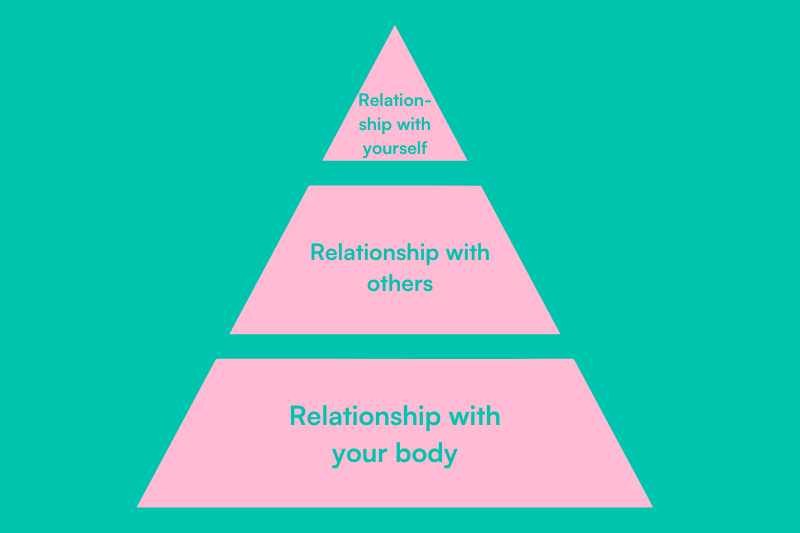
Whenever I guide my clients through body scans during our sessions, I frequently hear, “I didn’t realize my jaws were so clenched” or “my shoulders were really tense/hunched and I wasn’t even aware.” Disconnection from our bodies is the norm in our culture, yet this might be one of the most crucial starting places for tuning into our pleasure. A significant perspective shift occurs when we shift from focusing on performance during sex (how we appear) towards focusing instead on presence during sex (how we feel). This can sound like a daunting task, but the key is to start small with noticing neutral, mildly pleasant bodily sensations. For example, what does it feel like to brush your own hair? Or apply lotion to your arms and legs? Once comfort is established with these milder sensations, you can begin to explore what it feels like to more intentionally explore pleasure (for example, by gently caressing different parts of your body).
2. Unlearning shame-based narratives
Take some time to reflect on what narratives you have been shown about sex from your family of origin, the media, or your schooling environments. What were the messages around queer sex specifically? Did messaging around queer sex even exist in the first place? And if it didn’t, what did that lack of communication in itself communicate? It may also be helpful to reflect on what you were taught about requesting that your needs be met. For many queer folks, it may feel that the less noticeable you and your needs become, the more you will feel safe and
accepted within heteronormative culture. It may be helpful to ask yourself, “Do I feel selfish when I ask for my needs to be met (nonsexually)? And what narratives do I use to explain why I deserve less than others?”
3. Exploring Desire Without Pressure
Nothing kills the mood more than feeling like you have to feel pleasure to prove to yourself that you are not “broken.” Instead, try approaching sex and intimacy as if it were an experiment. All good experiments leave room for various outcomes without trying to control for any one specific outcome in particular. You may experiment with receiving oral sex from your partner, or using a dildo during self-pleasure, and find out that these activities aren’t turning you on. Great! You are now one step closer to identifying what works for you and what doesn’t. Desire is intended to emerge gradually, not something to force into existence. You’ve spent a long time being told (either directly or indirectly) that your version of sex is “wrong,” so it will take some time for your body to trust the safety that you are creating (and that is a very normal and expected part of the process).
4. Practice self-compassion
Struggling with desire does not mean you are bad, broken, or that there is something wrong with you. But rather, it is often a product of your environment and the culture you are raised in. Your challenges with desire may stem from direct and indirect messages you have received throughout your life in terms of what you are allowed to ask for and your right to feel good. Disconnecting from your pleasure may have protected you at one point in time, so it helps to appreciate these parts of us rather than push them away. Explore how you speak to yourself during your exploration with this pleasure – is it kind, compassionate, and patient? If not, what could you say instead that may help your body feel safer and understood? Self-compassion is not just a strategy towards self-pleasure, but rather a key ingredient in what makes pleasure possible.
Conclusion
Reconnecting with your pleasure isn’t just about sex; it is about returning home to yourself and your needs. It is about deconstructing narratives around what you are allowed to ask for, what you are allowed to feel, and who you are allowed to love. And you don’t have to go through this alone. Healing can be fostered in the community as well, so consider talking about your experiences transparently with your partner or friends (with their consent first!). Or, if you are working through deeper concerns, consider reaching out to a mental health professional to support you on your journey towards cultivating greater pleasure in your life.
Sex Positive Therapy at Expansive Therapy
At Expansive Therapy, we believe pleasure, connection, and self-understanding are important parts of mental health. If you’re looking for support on your healing journey, check out our homepage.
Want a safe space to explore your relationship with sex?
Expansive Therapy offers Sexuality Exploration Therapy in New York and California.
Reach out today for a free consult.
How Queer People Can Reclaim Pleasure and Desire
Just because we have experienced challenges with claiming our pleasure doesn’t mean it has to be that way forever. While sexually receiving can feel challenging in the moment, it is also a reliably treatable phenomenon. Here are a few options to explore on your own or with a mental health professional to begin your journey towards sexual reclamation:
1. Cultivating Bodily Awareness
Whenever I guide my clients through body scans during our sessions, I frequently hear, “I didn’t realize my jaws were so clenched” or “my shoulders were really tense/hunched and I wasn’t even aware.” Disconnection from our bodies is the norm in our culture, yet this might be one of the most crucial starting places for tuning into our pleasure. A significant perspective shift occurs when we shift from focusing on performance during sex (how we appear) towards focusing instead on presence during sex (how we feel). This can sound like a daunting task, but the key is to start small with noticing neutral, mildly pleasant bodily sensations. For example, what does it feel like to brush your own hair? Or apply lotion to your arms and legs? Once comfort is established with these milder sensations, you can begin to explore what it feels like to more intentionally explore pleasure (for example, by gently caressing different parts of your body).
2. Unlearning shame-based narratives
Take some time to reflect on what narratives you have been shown about sex from your family of origin, the media, or your schooling environments. What were the messages around queer sex specifically? Did messaging around queer sex even exist in the first place? And if it didn’t, what did that lack of communication in itself communicate? It may also be helpful to reflect on what you were taught about requesting that your needs be met. For many queer folks, it may feel that the less noticeable you and your needs become, the more you will feel safe and
accepted within heteronormative culture. It may be helpful to ask yourself, “Do I feel selfish when I ask for my needs to be met (nonsexually)? And what narratives do I use to explain why I deserve less than others?”
3. Exploring Desire Without Pressure
Nothing kills the mood more than feeling like you have to feel pleasure to prove to yourself that you are not “broken.” Instead, try approaching sex and intimacy as if it were an experiment. All good experiments leave room for various outcomes without trying to control for any one specific outcome in particular. You may experiment with receiving oral sex from your partner, or using a dildo during self-pleasure, and find out that these activities aren’t turning you on. Great! You are now one step closer to identifying what works for you and what doesn’t. Desire is intended to emerge gradually, not something to force into existence. You’ve spent a long time being told (either directly or indirectly) that your version of sex is “wrong,” so it will take some time for your body to trust the safety that you are creating (and that is a very normal and expected part of the process).
4. Practice self-compassion
Struggling with desire does not mean you are bad, broken, or that there is something wrong with you. But rather, it is often a product of your environment and the culture you are raised in. Your challenges with desire may stem from direct and indirect messages you have received throughout your life in terms of what you are allowed to ask for and your right to feel good. Disconnecting from your pleasure may have protected you at one point in time, so it helps to appreciate these parts of us rather than push them away. Explore how you speak to yourself during your exploration with this pleasure – is it kind, compassionate, and patient? If not, what could you say instead that may help your body feel safer and understood? Self-compassion is not just a strategy towards self-pleasure, but rather a key ingredient in what makes pleasure possible.
Conclusion
Reconnecting with your pleasure isn’t just about sex; it is about returning home to yourself and your needs. It is about deconstructing narratives around what you are allowed to ask for, what you are allowed to feel, and who you are allowed to love. And you don’t have to go through this alone. Healing can be fostered in the community as well, so consider talking about your experiences transparently with your partner or friends (with their consent first!). Or, if you are working through deeper concerns, consider reaching out to a mental health professional to support you on your journey towards cultivating greater pleasure in your life.
Sex Positive Therapy at Expansive Therapy
At Expansive Therapy, we believe pleasure, connection, and self-understanding are important parts of mental health. If you’re looking for support on your healing journey, check out our homepage.
Want a safe space to explore your relationship with sex?
Expansive Therapy offers Sexuality Exploration Therapy in New York and California.
Reach out today for a free consult.
Want more content like this?
Join our mailing list
Want more content like this?
Join our mailing list
Want more content like this?
Join our mailing list
Book Your Intro Session With A Therapist